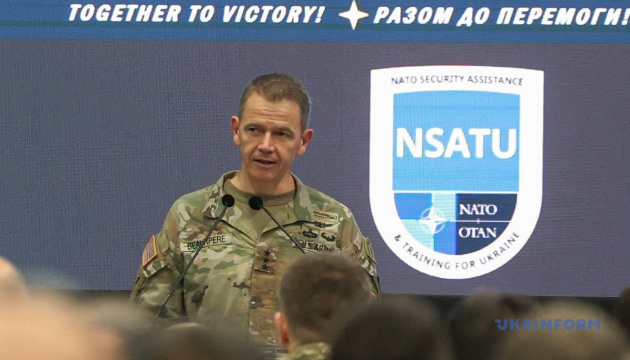
NSATU Commander Lieutenant General Guillaume N. Beaurpere said this in an interview with Ukrinform.
“Cyber is a war fighting domain. We have to accept that as a joint force, as an Alliance. It's part of our doctrine now. We recognize it as a warfighting domain. The electromagnetic spectrum is a domain as of itself, and in many ways, it is contested, it is constantly denied. So, it's just inherent in any military operation right now,” Beaurpere said.
He added that, when conceptualizing future wars, NATO can no longer view warfare solely in traditional domains – on land, at sea and in the air – as the electromagnetic spectrum and cyberspace “will absolutely be part of future war.”
The general explained that this is taken into account in the way training is coordinated and the Defense Forces of Ukraine are equipped with the necessary tools to maintain an advantage in these conditions of intense confrontation.
“We account for that through the feedback we get from the Ukrainian General Staff and making sure that curriculum at training centers, basic recruit training all the way up to command and staff training for a corps level accounts for these warfighting domains, that it learns and trains on how to integrate those going forward,” he said.
He added that electronic warfare systems, radar stations and jamming systems remain on Ukraine’s Comprehensive Requirements List as critically important components for stabilizing the front line today, while capability coalitions are simultaneously working to anticipate future technological challenges.
Read also: NATO focuses on building integrated air defense ecosystem for Ukraine – NSATU commanderAs Ukrinform reported, on November 17, a meeting of the Ukraine Defense Contact Group was held at NATO Headquarters in Brussels. Participants discussed the urgent needs of the Armed Forces of Ukraine to stabilize the front line and maintain the Ukrainian military’s technological edge on the battlefield.